

Quality education has always been a cornerstone for any thriving city. Edmonton’s first public schools laid a strong foundation for the city’s educational system. This article on edmonton1.one delves into the fascinating history of how Edmonton’s initial schools came to be and evolved.
How the First Schools Emerged
In the late 19th century, a significant wave of immigration swelled Edmonton’s population. This growth spurred local authorities to embark on an ambitious program to expand the city’s educational infrastructure.
The city’s very first school opened its doors in 1881, nestled in the North Saskatchewan River valley. It was a simple wooden-framed building. This wasn’t just Edmonton’s first school; it was also Alberta’s first free public school. Today, this historic building houses the Edmonton Public Schools Museum.
Between 1881, when that first school was established, and the end of World War I in 1918, a remarkable 24 permanent schools were built. These early schools are sprinkled throughout the city’s residential streets. They can be tricky to spot now, often hidden amidst larger, more modern buildings and mature trees.
How the First School Operated
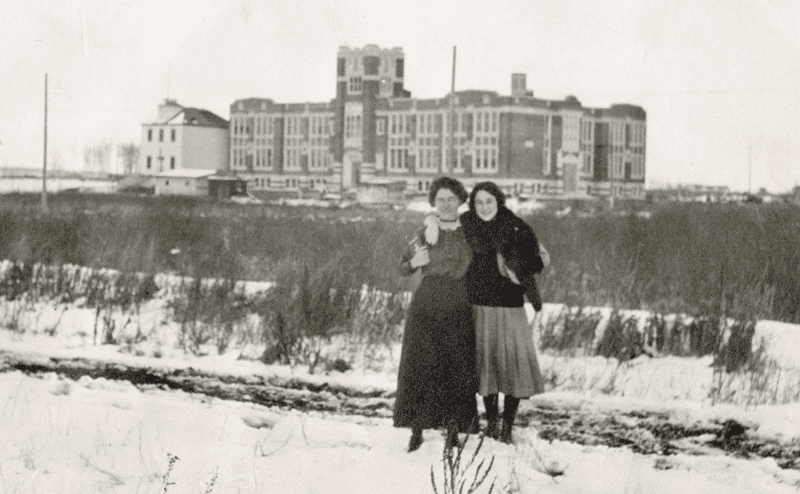
The organizational aspects of the first school were managed by the Department of Education of the North-West Territories (Edmonton School District No. 7), which was founded in 1885. As the dream of a robust school system began to materialize, financial questions quickly arose. For instance, who would cover the teachers’ salaries at that first school? The idea of establishing a private school was floated but swiftly dismissed in favour of a free public option.
For a time, a subscription model was used, but the majority of the costs still fell on the school’s founders. By 1885, the school system was granted taxing authority, meaning the community began to cover school expenses. This made education accessible to all children. It marked the first instance of a local self-governing body implementing taxes for the residents of the Edmonton community.
Edmonton Public Schools Museum
Edmonton is even home to the Edmonton Public Schools Museum. It’s housed in the former McKay Avenue School, a building erected in 1881 with funds raised by prominent city politicians Matthew McCauley, William Rowland, and Malcolm Groat. Initially, a small wooden school was built, but Edmonton was growing rapidly at the time and soon needed a larger facility. It was decided to rebuild the school, with an architect tasked to design a three-storey building. The new institution was constructed in the Richardsonian Romanesque architectural style.
In 1906 and 1907, the school served as the meeting place for the Alberta Legislative Assembly. A number of crucial bills were passed here, including the decision to make Edmonton the capital of Alberta, and the establishment of the University of Alberta.
The school closed its doors in 1983 due to declining student numbers in downtown Edmonton. Since then, it has been home to the Edmonton Public Schools Museum. The museum is a public research centre dedicated to preserving various artifacts related to the city’s public schools. It also offers diverse educational programs. The museum even maintains a preserved 1950s-era classroom and a 1906 legislative assembly meeting room. Between 2019 and 2020, this museum hosted a renowned international travelling exhibition from the Anne Frank House.
McKay Avenue School stands as an exemplary piece of Richardsonian Romanesque architecture, embodying the enthusiasm and burgeoning sophistication of Edmonton in that era.
The story of Edmonton’s first school and the evolution of its school system is an inspiring tale from the past. It represents a profoundly significant and courageous step taken by its three founders, who truly opened the doors of education for the city’s younger generations.