

Edmonton has been home to many talented artists, and one of the most distinguished among them was Alex Janvier. His contributions to art were invaluable—a muralist, painter, community leader, and educator, he left a lasting impact on Canadian culture. His works are featured in prestigious public collections, including the National Gallery of Canada and the Canadian Museum of Civilization. Read more about his extraordinary life and artistic journey on edmonton1.one.
A Difficult Childhood
Alex Janvier was born on February 28, 1935, in the Le Goff Reserve of the Cold Lake First Nation, near Edmonton. His father was the last hereditary chief of the tribe before federal laws mandated the election of band officials.
At the age of eight, Alex was taken from his family and sent to Blue Quills Residential School near St. Paul, Alberta. There, he endured abuse, confusion, and loneliness. However, throughout this challenging period, he found solace in drawing and painting.
Recognizing Janvier’s exceptional artistic abilities, the school principal arranged private art lessons with Professor Carlo Altenberg. His first artistic creations were produced while at the residential school.
In 1960, Janvier graduated from the Alberta College of Art and Design. After a brief teaching career, he dedicated himself fully to painting in 1962.
A Unique Artistic Style
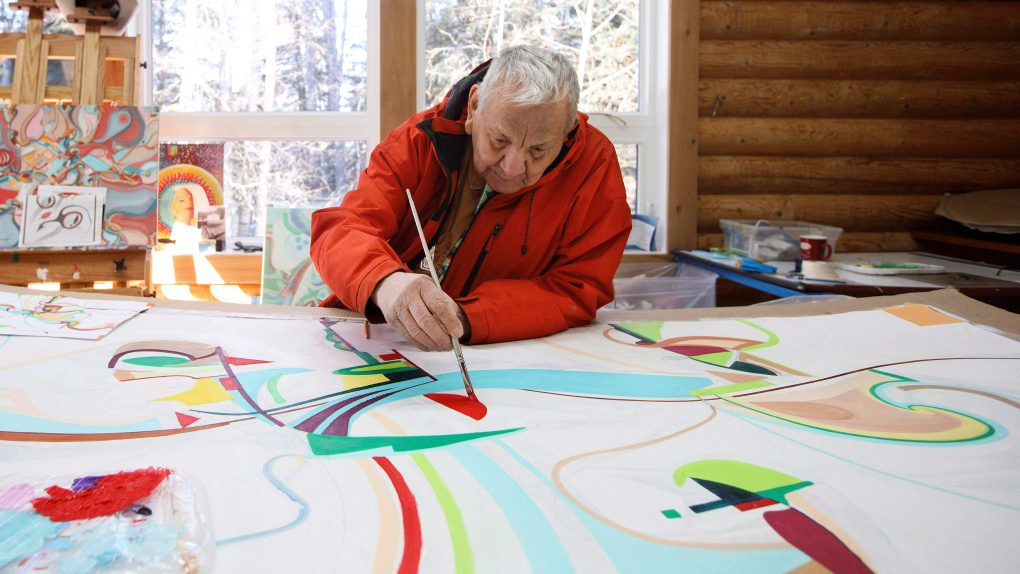
Janvier quickly developed his distinctive artistic style, deeply rooted in the cultural and spiritual elements of his Dene heritage. His abstract technique was influenced by European modernists such as Paul Klee and Joan Miró.
Beyond crafting his signature style, Janvier became a trailblazer for Indigenous artists. In 1966, the federal government commissioned him to create 80 paintings for the Department of Indian Affairs.
As a consultant for the Indian Pavilion at Expo ’67 in Montreal, Janvier brought together Indigenous artists from across Canada to establish an Indigenous advisory group. He was among five artists chosen to create circular murals—each spanning over nine feet in diameter—for the pavilion.
Upon returning to Alberta, Janvier met Jacqueline, the woman who would soon become his wife. In 1971, he decided to pursue a full-time career as an artist. With Jacqueline’s support, he founded Janvier Murals and Fine Arts.
Between 1974 and 1975, his paintings were included in an Alberta Art Foundation exhibition, which was displayed in London, Paris, and Montreal.
Public Murals and National Recognition
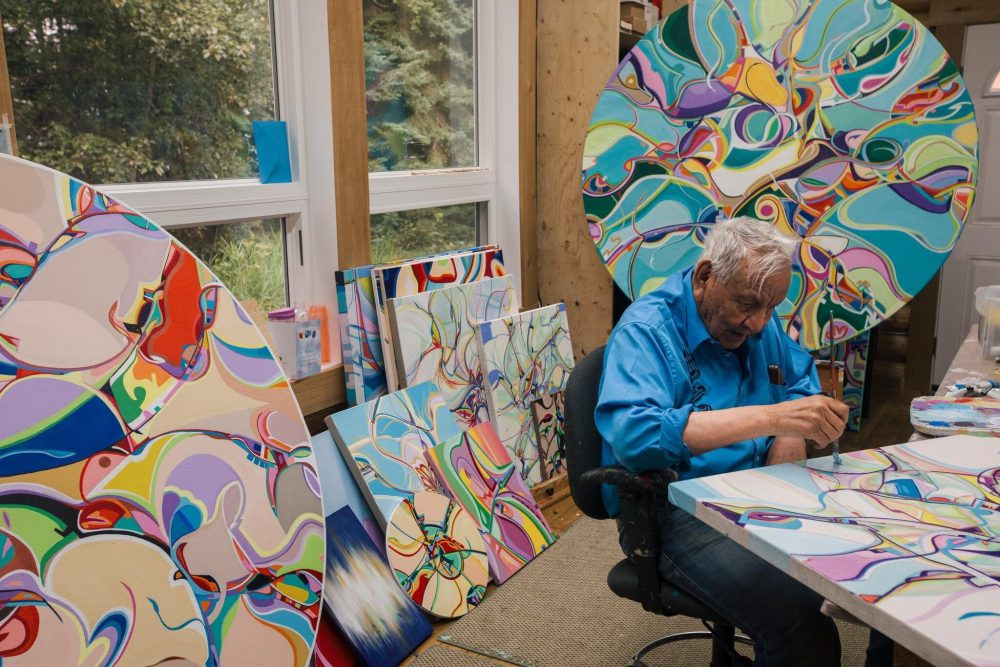
Throughout the 1970s, Janvier refined his artistic approach and created numerous murals across Canadian cities. His notable works from this era include:
- The mural at the Explorer Hotel in Yellowknife
- The Muttart Conservatory mural in Edmonton
- The Beverly Hills mural, which spans three tiers and a large spiral staircase at the Strathcona County Administration Building in Sherwood Park
In 1976, Janvier returned to Cold Lake for a period of isolation and reflection, which greatly influenced his creative resurgence. The following year, he participated in an art exhibition in Linköping, Sweden.
By 1985, his international reputation had expanded, and he was selected as Canada’s representative for a cultural exchange program with China.
In 1992, his work was featured in the major contemporary art exhibition “Land, Spirit, Power.”
In 1998, Janvier was commissioned by the Royal Canadian Mint to design a $200 commemorative coin.
A defining moment in his career came in 2009, when his work was exhibited in two major art shows in France, showcasing his distinct artistic vision.
In 2010, Janvier completed two new murals on the balcony of the Strathcona County Administration Building in Sherwood Park.
His most significant career exhibition was curated by the National Gallery of Canada, featuring over 150 of his works, including:
- “Untitled” (1986)
- “Lubicon” (1988)
In 2016, Janvier created a 149-square-meter circular floor mosaic titled “Tsa Tsa Ke K’e” for the Winter Garden at Rogers Place in Edmonton.
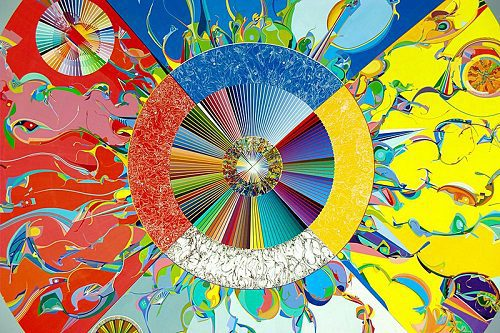
Janvier’s most celebrated masterpiece is “Morning Star” (1993)—a 4,500-square-foot mural adorning the domed ceiling of the Canadian Museum of History in Gatineau, Quebec.
The composition features two concentric circles at the center, radiating outward in four color-coded sections:
- Yellow – Symbolizes harmony with nature and spiritual forces
- Blue – Represents the oppression of Indigenous cultures by European influences
- Red – Stands for cultural resurgence and Indigenous resilience
- White – Embodies the restoration of harmony
Janvier’s visionary artistry became an integral part of Canadian art, illuminating Indigenous experiences and ensuring their preservation for future generations.The legendary artist passed away on July 10, 2024, leaving behind a legacy of cultural significance and artistic brilliance.