

The North-West Mounted Police (NWMP) was the predecessor of the iconic Royal Canadian Mounted Police (RCMP). It was established after Confederation to maintain law and order in Canada’s western frontier. The mounted police played a key role in suppressing the North-West Rebellion and restoring order during the Klondike Gold Rush. Read more on edmonton1.one.
The Creation of the Mounted Police
In May 1873, the Canadian Parliament passed an act establishing the “Mounted Police for the North-West Territories.” At that time, these territories included Alberta, Hudson Bay, Manitoba, and parts of Saskatchewan.
The decision to form the mounted police was driven by illegal whiskey trade and lawlessness in the region. John A. Macdonald sought to deploy military forces from Ottawa to protect Canada’s sovereignty and lay the groundwork for peaceful conflict resolution.
Traders from Fort Benton, Montana, had illegally entered Alberta, setting up trading posts in the south. In exchange for buffalo hides from Indigenous peoples, they traded blankets, weapons, and ammunition.
However, the most profitable product was alcohol. With no law enforcement to stop them, violence, murders, and robberies became rampant. Lieutenant William Butler, an officer in the British Army, reported on these growing issues in a local newspaper.
The First Police Recruits
The North-West Mounted Police was modeled after the Royal Irish Constabulary. The uniform was distinctive—a red tunic and blue trousers.
Applicants had to be physically fit men aged 18 to 40, proficient in English, literate, and skilled horse riders. The daily wage was 75 cents. Men from various social backgrounds applied, but preference was given to those with military or law enforcement experience.
Only young and healthy horses were provided to officers. Each policeman was assigned his own horse, responsible for feeding, grooming, and overall care.
By August 1873, the first 150 recruits were sent to Winnipeg, where they trained under the first commissioner, George French. Their training was modeled on cavalry regiments, focusing on the use of revolvers, carbines, and light artillery.
A Major Expedition
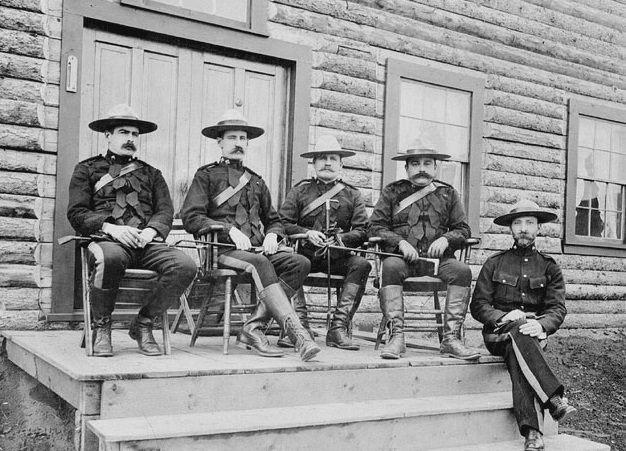
In 1874, 300 officers and soldiers from the Mounted Police embarked on an exhausting 1,300-kilometre march from Manitoba across the trackless prairies. Facing extreme weather, hunger, and disease, both men and horses endured severe conditions before reaching La Roche Percée in southern Saskatchewan.
The unit then split—one group moved westward to establish a police post at Fort Edmonton, while another traveled south to Fort Benton to purchase supplies and young horses.
By the time the police arrived in Fort Edmonton, most of the outlaws had fled, effectively ending the illegal trade without a single shot being fired.
The Klondike and a Period of Change
In 1896, Inspector Charles Constantine had already established a police outpost near the Yukon settlement of Forty Mile when news broke of a massive gold discovery on the Klondike River. This sparked a rush of fortune seekers heading north.
The Mounted Police quickly set up checkpoints along the main routes to Dawson City, the capital of the Gold Rush. Their presence ensured law and order, making the gold rush one of the most organized in history, relatively free from criminal activity.
During World War I, members of the Mounted Police were exempt from military service, as they were needed on the home front to prevent enemy sabotage operations.In 1920, several divisions of the Mounted Police merged, officially forming the Royal Canadian Mounted Police (RCMP)—the force that continues to uphold law and order in Canada today.