

The history of Misericordia Hospital dates back to 1900 when four nuns and a nurse arrived in Edmonton from Quebec. Their mission was to establish a healthcare facility in the city. Read more about the hospital’s development in this article on edmonton1.one.
Providing the First Medical Aid
Sister Francisca d’Assisi (the superior), Sisters Laurent, Rosa, and Frederica, along with nurse Mary Kennedy, responded to the invitation of Bishop Grandin of the Diocese of St. Albert. His vision was to create a hospital capable of serving 3,000 residents of Edmonton.
Initially, the city lacked a suitable building for the new medical facility. The sisters began offering care in a warehouse. They were allocated four basement rooms at the southwest corner of 111th Street and 98th Avenue. News of free medical care quickly spread, and demand surged. The sisters’ work soon expanded beyond its initial scope, with their first patients being unmarried or divorced women with children.
Construction of the Hospital and Opening of the Nursing School
In 1906, the city allocated land for the hospital at 111th Street and 99th Avenue. Architect J. Sencal from Manitoba designed the facility.
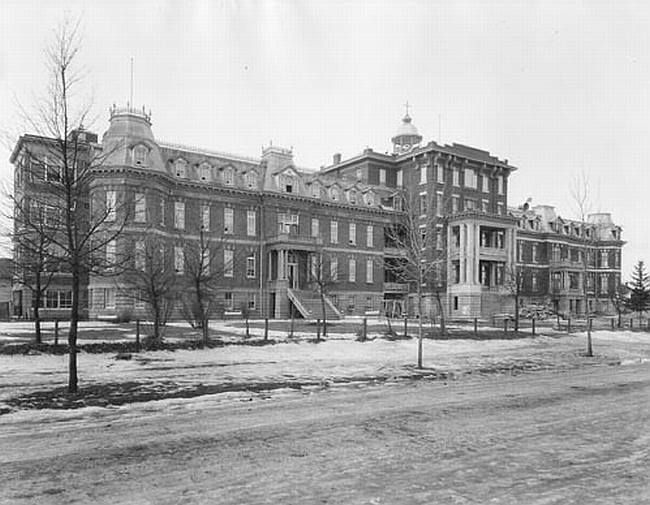
A three-story brick building with 60 beds was constructed in the French Second Empire architectural style, characterized by high windows, ornate moldings, a mansard roof, and a corner tower. The basement was built with rusticated stone, and each window featured elegant voussoirs. A prominent stone belt course and dentil cornices separated the first and second floors.
The hospital’s entrance and façade featured porches with Tuscan columns supporting a second-floor balcony. The basement housed a kitchen, laundry, and boiler room. Administrative offices, a chapel, an outpatient clinic, and an operating room occupied the first floor. The second floor included a maternity ward, a separate kitchen, and another operating room. Two men’s wards were located on the third floor.
In 1907, the Misericordia Sisters opened a nursing school, graduating its first students in 1910. Over its history, the school trained more than 2,000 nurses.
As Edmonton grew, so did the hospital. In 1914, a solarium was added to the southern façade. In 1922, architect Edward Underwood designed an expansion, increasing the hospital’s capacity to 175 beds.
In 1936, a two-story nurses’ residence was constructed on the hospital grounds, and in 1940, Rule and Wynn designed a maternity wing with 150 beds. By 1949, a school building was added to the nurses’ residence, combining the two facilities under one roof.
Expansion and Modernization
In 1952, Rule and Wynn designed an east wing and emergency exit, costing $500,000. The new addition, with 61 beds, was clad in red brick and featured a copper canopy above the entrance. A large sign displaying the hospital’s name adorned the roof.
Three years later, the same architects designed the west wing. The five-story addition, similar in design to the east wing, included eight operating rooms, 82 beds for children and adults, a kitchen, and living quarters for nurses. The hospital’s total capacity reached 400 patients.
Transition and Demolition
In 1959, a boiler explosion caused a fire, damaging parts of the building. By 1969, the hospital relocated to a new facility. By 1972, only the east and west wings of the original complex remained, temporarily housing children with developmental disabilities. In 1973, the original Misericordia Hospital was demolished.