

Dr. Merle Olson is a name known worldwide. He’s not only a veterinarian, researcher, and educator but also a highly successful entrepreneur. Alongside his wife, he’s co-founded numerous biotech and pharmaceutical companies specializing in veterinary products for animals. We’ll dive deeper into Merle’s life and business journey on edmonton1.one.
Childhood and Young Adulthood
Merle was born in Radville, Saskatchewan, on November 13, 1953. His parents owned a 640-acre mixed farm between Radville and Ceylon, where they grew wheat and raised cattle, chickens, and pigs. From the age of 12, Merle helped his folks care for the livestock. Daily chores like collecting eggs, milking cows, and feeding pigs sparked his early interest in animal agriculture.
Merle attended school in the village of Ceylon, and when winter snows made roads impassable, he switched to homeschooling. Eager to earn some extra cash, he trapped beavers, minks, and muskrats, selling the pelts to the Hudson’s Bay Company. Despite what’s now recognized as Attention Deficit Disorder, Merle was a good student, excelling particularly in math and science. His parents were incredibly supportive and believed strongly in the importance of education. Thanks to their encouragement, he graduated in 1971 as the valedictorian of his class of 10.
After high school, he wavered between a career in agriculture and pursuing academics. Ultimately, he decided to broaden his knowledge and enrolled at the University of Saskatchewan. The shift from quiet farm life to the bustling city was tough, but his passion for science and math helped him thrive, both in his studies and in life. In 1975, he earned a Bachelor of Science with honours in Chemistry and Biology, completing a four-year program in just five years.
A Natural Sciences and Engineering Research Council scholarship took Merle clear across the country. He moved to the University of Western Ontario, where he pursued his master’s degree. He quickly adapted to life at the prestigious eastern university and excelled academically, publishing some of his first scientific papers. In 1977, Olson earned his Master’s in Electrochemistry. However, realizing his true calling was to help animals, he enrolled in the Western College of Veterinary Medicine at the University of Saskatchewan that very fall.
First Steps in Animal Care
Even with his demanding studies, Merle found time to take ballroom dancing classes. One evening after a class, Merle stopped to help fix a flat tire and met Barb, a graduate student in veterinary physiology. A relationship quickly blossomed between them, leading to marriage. His wife became Merle’s rock and partner in both his scientific and business ventures. In an interview, Olson mentioned that he and his wife share a deep love for research, spending time outdoors, and being around animals. After graduating from university in 1981, Olson began practicing veterinary medicine. Life in the busy farming and ranching community, with its abundance of cattle, proved demanding, as Merle dedicated all his time to his work.
Academic Career and Scientific Discoveries
Despite his dedication to his practice, Olson returned to academia in 1984, taking on a teaching position in the Department of Biological Sciences and later Medicine at the University of Calgary. Merle spent two decades within Alberta’s higher education system. Together with his wife, he spearheaded numerous applied research programs in microbiology and pharmacology. The Olsons also conducted groundbreaking research on the impact of bacterial biofilms on chronic infectious diseases. Their work led to the development of the first diagnostic kit to help clinicians choose the best antimicrobial agents for treating cystic fibrosis-related infections. The “Calgary Biofilm Device” is now used worldwide in both human and veterinary medicine.
It’s important to note that during his time at the University of Calgary, Merle actively collaborated with government agencies to address issues within the agro-industrial sector. For instance, he led the development of Alfasure, a product that allows cattle to graze on high-protein alfalfa without the risk of bloat. One version of the product was developed in New Zealand but was banned in Canada due to a hazardous ingredient. Merle soon created a new formulation that met Canadian standards and began production here in Canada.
Venturing into Business
In 2004, Merle and his wife made a joint decision to retire early from the university and launch their own business. Olson’s extensive experience, both as a rural veterinarian and an urban professor, came together, shaping the next chapter of his life.
As a veterinarian, he saw firsthand the unmet needs that livestock producers faced daily. One of the most common was pain management for cattle. As a professor, he was frustrated that many local biotech products stayed in the lab for too long or moved to other jurisdictions before reaching the Canadian market. At that time, nearly all major pharmaceutical products for the livestock industry were manufactured outside of Canada. This created a significant problem for Alberta producers, who had to pay more for products not developed with the province’s climate and geographical specifics in mind. The Olsons believed that all veterinary products should be made and tested right here in Alberta.
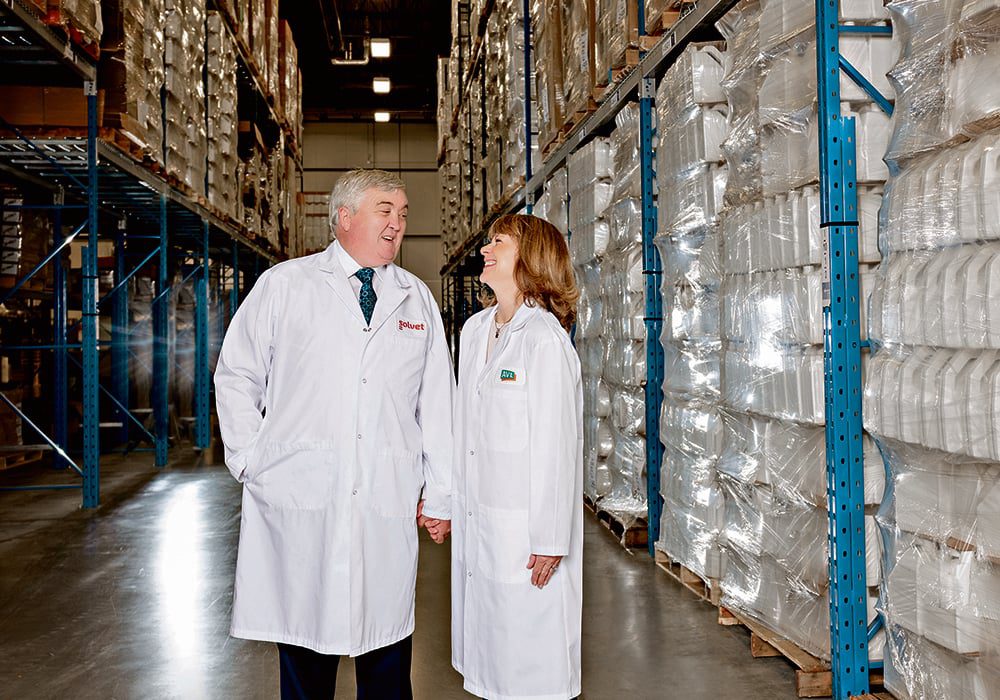
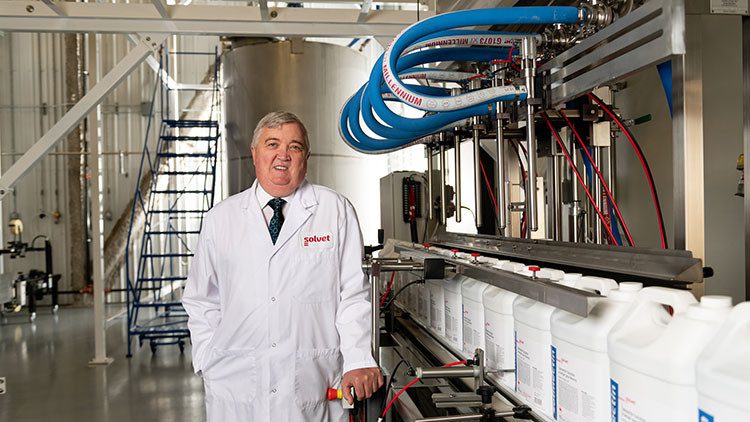
Merle and Barb decided to launch biotech ventures in Alberta to better serve the livestock industry, basing their model on direct communication with farmers and veterinarians. This led to the founding of Innovotech, a publicly traded biotech company now based in Edmonton, which manufactures products and provides services based on the Olsons’ years of biofilm research. Alberta Veterinary Laboratories (AVL) and Solvet Animal Health conduct research and produce veterinary pharmaceuticals for livestock, and they’re considered leaders in the field. The Olsons also built a modern veterinary pharmaceutical manufacturing plant in Calgary. Alberta Veterinary Laboratories has earned widespread recognition and respect among farmers and ranchers for developing an economical and effective solution for parasite control in cattle. Similar products were significantly more expensive, forcing producers to compromise profitability or risk herd health. AVL’s Ivermectin Pour-On for cattle created a sensation in the market in 2009, saving the industry an estimated $9 million annually while improving animal health and welfare.
Thanks to its relentless commitment to innovation, AVL registered and began selling at least one new veterinary product every year. The company’s pain management products are now used to treat livestock across Canada. AVL also developed tablets for the treatment and prevention of metabolic diseases in cattle and new products designed to reduce antibiotic use in agriculture and livestock farming. The company employs over 50 staff, including renowned chemists, biochemists, pharmacists, and veterinarians.
For his extensive achievements, Merle has received numerous awards. The Olsons’ business success stems from their passion for their work and their unwavering support for each other. The family holds over 50 patents in medicine, parasitology, and pharmacology. Additionally, they have authored over 250 peer-reviewed publications and 13 book chapters.