

Archbishop Henry Joseph O’Leary played a key role in establishing a seminary in the province, becoming one of the first to build a strong foundation for clergy formation in Edmonton. How did it all begin? Learn more in this article on edmonton1.one.
How It All Began
In 1894, a building located at the corner of 110th Street and 100th Avenue belonged to the Oblates of Mary Immaculate, an institution for higher education. The active missionary work of the Oblates in Western Canada inspired Archbishop Émile Legal in 1917 to convert the institution into an Oblate School. By 1919, a chapel and several additional rooms had been added to accommodate growing needs.
By the mid-1920s, the school building was too small to house the increasing number of Oblates and diocesan seminarians. Archbishop O’Leary envisioned establishing a full-fledged seminary. Learning that the Oblates planned to relocate, he entered negotiations and successfully secured the property.
In 1927, the Oblates moved to their new location in Lebret, and in September of the same year, Archbishop O’Leary officially opened St. Joseph Seminary.
The seminary’s first rector was Rev. James McGuigan, who served as the Vicar General of the Archdiocese of Edmonton. Upon its opening, the seminary welcomed its first class of 50 students, who came from across Western Canada, the British Isles, and Ireland.
In spring 1930, after McGuigan was appointed Archbishop of Regina, Rev. M.C. O’Neill took over as rector. A year later, O’Neill was called to military service, and his successor, Howard Griffin, led the seminary for the next 25 years.
Over its first 30 years, St. Joseph Seminary graduated more than 300 students, most of whom went on to serve in the Archdiocese of Edmonton.
Expansion and the Construction of a New Seminary
Following World War II, St. Joseph Seminary entered a period of significant growth. In 1955, its leadership decided to build a new seminary facility. They purchased more than 100 acres of land, located two miles south of St. Albert. Bishop Nelson was assigned as the project overseer.
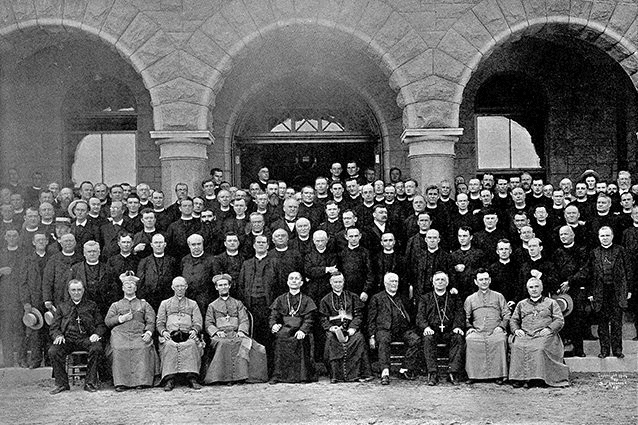
One of the most active contributors to the project was James McGuigan, the seminary’s first rector. On September 26, 1957, St. Joseph Seminary officially relocated to its new premises. The grand opening was attended by bishops from across Central Canada. The new facility could accommodate 80 students, providing them with modern living and study conditions.
In 1965, Rector Howard Griffin passed away, and Rev. Alois Schen was appointed to replace him.
The Connection Between Newman College and St. Joseph Seminary
In 1969, Newman College was formally established on the grounds of St. Joseph Seminary. Though separate institutions, both shared a common mission—to serve the Church in Western Canada. They also operated in the same building.
Notably, Newman College’s academic curriculum mirrored that of St. Joseph Seminary, ensuring a strong theological foundation for its students. As an accredited post-secondary institution, Newman College became an integral part of St. Joseph Seminary’s academic structure.
The Formation of the Society of St. Sulpice
Another important transformation occurred in 1990, when the Society of St. Sulpice was established within the seminary. The Sulpicians specialized in the formation of priests, bringing distinguished clergy members to teach at St. Joseph Seminary.
For decades, the seminary lacked a dedicated library. This changed in 1997, when a library was officially opened within the institution, providing students with access to essential theological resources.
In 2007, a decision by the provincial government required both St. Joseph Seminary and Newman College to relocate. Their new home was designated in the Ottewell neighbourhood.
Over the decades, St. Joseph Seminary has trained more than 500 clergy members. Today, in the 21st century, the institution continues its mission, upholding its tradition of excellence in theological education and priestly formation.