

Edmonton’s ice harvesting industry played a vital role in the city’s history. Captured in Hubert Hollingworth’s renowned collection at the Edmonton Archives are unique photographs depicting men harvesting ice from the frozen North Saskatchewan River. This once-thriving occupation was a significant source of income for many. Learn about the fascinating process and purpose of ice harvesting on edmonton1.one.
Harvesting and Transporting Ice
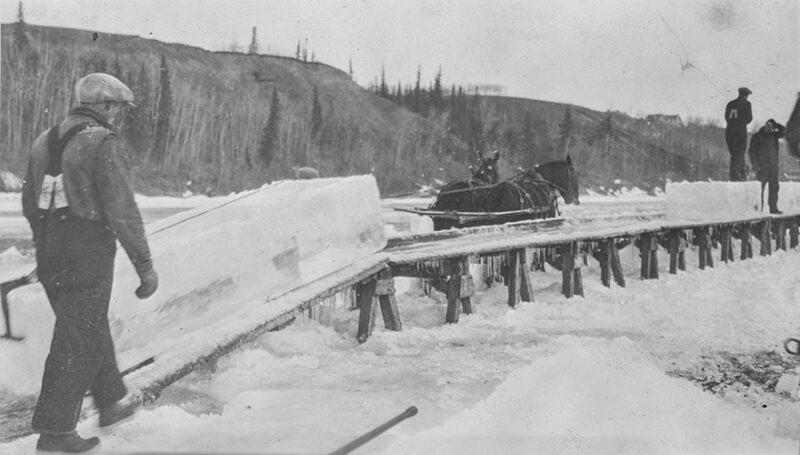
Ice was cut into small blocks while still in the water, using saws. Workers would then use hooks attached to chains to lift the blocks out of the river. The ice was hauled by horse-drawn sleds to nearby storage facilities. These blocks weighed between 50 and 100 pounds each. Nearby icehouses could store up to 8,000 tons of ice—enough to last through the summer. Edmonton’s ice was even exported to other countries due to its high quality.
Ice was harvested for various purposes, including preserving food and supplying cafés and restaurants. It was also heavily used in non-mechanical refrigerator cars to protect shipments of fruits, vegetables, and frozen goods. An article in the Edmonton Journal described ice as a simple and natural way to maintain low temperatures at an affordable cost.
The ice from the North Saskatchewan River was prized for its purity and clarity. A 1912 publication noted that the ice was formed from snowmelt filtered through gravel beds, making it soft and transparent.
The Early Ice Companies
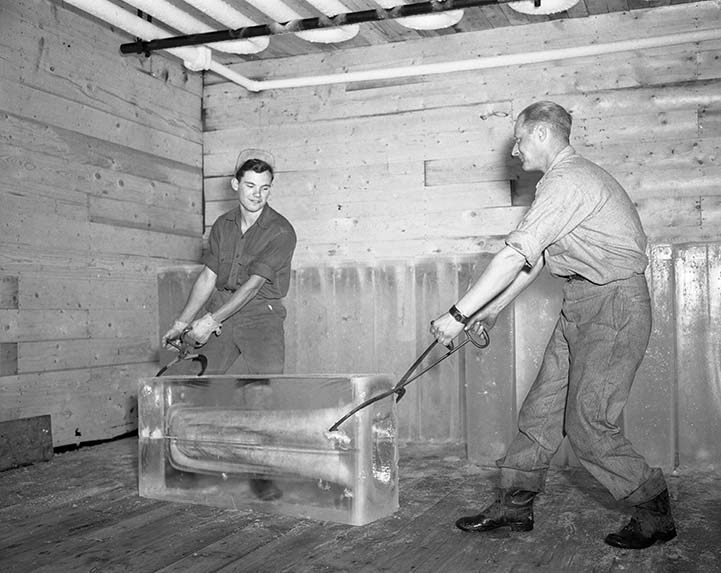
By 1912, several ice companies, including Twin City and Arctic Ice Company, were established in Edmonton. Their headquarters were located in Rossdale near 100th Street, where large icehouses, stables for horses, and delivery wagons were also stationed.
Ice was harvested upstream from the city to ensure its quality. This seasonal work was physically demanding, and ice-harvesting teams consisted of 40 to 60 strong, healthy men.
James Gillette, an ice cutter for Arctic Ice Company, once shared in an interview that he served 62 regular customers in his neighborhood. Ice trading was lucrative; workers earned up to $3 per day—a significant sum at the time.
Development of the Ice Industry
Although electric refrigerators started gaining popularity in the 1920s, Arctic Ice Company remained optimistic about the future of ice harvesting. In Rossdale, the company built a state-of-the-art storage and processing plant to keep up with demand.
By 1949, horses were replaced by trucks for ice transportation. That same year, Arctic Ice Company constructed a $150,000 plant capable of producing 72 tons of ice per day, sufficient to meet the needs of Edmonton’s residents. The Edmonton Journal described the plant as the most advanced of its kind in Canada. It began producing artificial ice blocks with precise dimensions for ease of use.
Despite the rise of artificial ice, natural ice was still harvested, particularly from Lake Wabamun. Blocks measuring 600 feet were cut and transported to facilities owned by the National Railway, which stored them in icehouses in Calder and Jasper.
Decline of the Ice Industry
The Arctic Ice plant operated until 1978, when it was deemed a fire hazard and too costly to maintain. The widespread adoption of refrigeration technology ultimately rendered ice harvesting obsolete. However, the legacy of Edmonton’s ice industry remains an integral part of the city’s history.